Is Commercial Plywood Suitable for Wholesale Buyers?
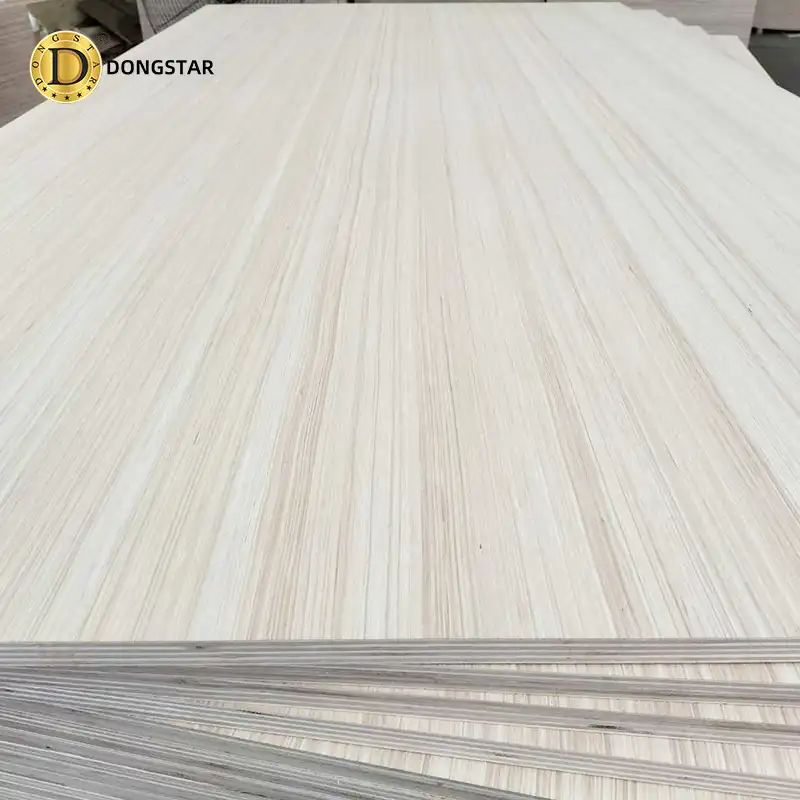
Yes. Commercial plywood can suit wholesale buyers when the panel specification matches the resale market and the supplier can repeat the same construction over large batches. A standard 1220 × 2440 mm sheet provides about 2.98 m² of panel area, while common thicknesses from 3 mm to 25 mm cover furniture, cabinetry, partitions, packaging, and interior fit-out. For US hardwood plywood, EPA TSCA Title VI sets a formaldehyde limit of 0.05 ppm for both veneer-core and composite-core products. For European trade, timber origin documentation also matters as EUDR application expands from 30 December 2026.
Wholesale suitability starts with construction rather than appearance. Two 18 mm panels can look almost identical on the pallet while using different veneer species, ply counts, glue systems, face grades, moisture levels, and internal repair standards. Buyers placing 500-sheet or 2,000-sheet orders need those items written into the purchase specification before production.
A 1220 × 2440 mm sheet has an area of 2.9768 m². An order of 1,000 sheets therefore represents almost 2,977 m² of panel surface, so a defect affecting only 2% of production can involve roughly 20 sheets and nearly 60 m² of material. Small production differences become expensive when the order is repeated every month.
The specification should normally state:
-
Finished length and width, including tolerance.
-
Nominal and actual finished thickness.
-
Face and back veneer species and grade.
-
Core species, veneer arrangement, and accepted repairs.
-
Glue type and intended service environment.
-
Maximum accepted core gaps, overlaps, and delamination.
-
Moisture requirement at packing.
-
Surface sanding or calibration requirement.
-
Emission standard required by the destination market.
-
Pallet height, edge protection, labels, and batch identification.
Thickness deserves separate attention because a quoted “18 mm” panel may not finish at exactly 18.00 mm after sanding. If a furniture factory uses CNC machining, dowels, grooves, or fixed hardware dimensions, even a difference of several tenths of a millimetre can affect assembly across a batch of 500 or 1,000 panels.
Wholesale buyers should therefore agree on measurable tolerances instead of using wording such as “standard thickness.” A sampling plan can record thickness at several points across randomly selected sheets rather than measuring one panel from the top of each pallet.
The same approach applies to the core. Poplar, eucalyptus, hardwood, mixed hardwood, and combination constructions can differ in density, screw holding, machining behaviour, panel weight, and price. A quotation that states only “commercial plywood” gives the buyer too little information to compare two factories on equal terms.
Ply count also needs context. More plies can produce a more uniform structure, but ply count alone does not establish panel quality. Veneer thickness, veneer grading, gaps, overlaps, adhesive spread, pressing conditions, and moisture control all affect the finished board, so a 13-ply panel should not automatically be treated as better than an 11-ply panel.
Bonding requirements should follow the expected environment. European plywood specifications commonly distinguish panels intended for dry, humid, and exterior conditions under the EN 636 framework, while bonding quality is assessed separately under EN 314. A buyer supplying indoor furniture should not pay for exposure performance that the application does not require.
The opposite mistake costs more. Plywood intended for a humid service environment should not be purchased from a specification written only around surface grade and price. A shipment of 800 panels can pass a visual inspection and still create claims later if bond performance was never defined.
Formaldehyde requirements also vary by market. In the United States, EPA rules cover manufacturers, importers, distributors, retailers, and other parties dealing with regulated composite wood products; the limit for hardwood plywood with veneer or composite cores is 0.05 ppm.
For that reason, an importer should ask which test method, production line, panel construction, and certification scope are covered by the supplied documents. A report issued in 2024 for one panel type should not automatically be treated as documentation for every thickness, core structure, or glue system sold in 2026.
Surface grade affects both purchase cost and downstream processing. A cabinet manufacturer applying laminate may accept filled veneer repairs that would be unsuitable for transparent coating, while a furniture buyer using painted panels may place more weight on sanding consistency than natural grain appearance.
A wholesaler can therefore separate stock by application instead of buying the same face grade for every customer:
| End use | Purchasing focus | Common specification concern |
|---|---|---|
| Cabinet carcasses | Flatness and machining | Thickness consistency |
| Laminated furniture | Stable surface | Repairs and sanding |
| Interior partitions | Panel stability | Bond and dimensional tolerance |
| Packaging | Cost and basic strength | Core construction |
| Decorative furniture | Face appearance | Veneer grade and patching |
| Reusable construction panels | Surface durability | Film, edges, and bonding |
Film-faced products should be treated as a separate purchasing specification. Black Film Faced Plywood normally uses a resin-impregnated film surface for applications where a smoother, more durable face is required, so film weight, panel core, edge sealing, reuse expectations, and bond performance should be discussed separately from ordinary commercial plywood.
Price comparisons become more useful when buyers calculate cost per usable sheet rather than invoice price alone. If Supplier A is 4% cheaper but 6% of delivered sheets need discounting, sorting, repair, or replacement, the initial price difference may disappear before warehouse and customer-service costs are included.
For a 2,000-sheet purchase, a 1% rejection rate equals 20 sheets; a 5% rate equals 100 sheets. Recording rejected quantity by defect type—delamination, thickness, face damage, edge damage, warping, core gap, or packaging damage—gives a wholesaler much better purchasing data for the next order.
Packaging should also be written into the contract. Export plywood may travel through factory handling, inland transport, port storage, ocean freight, customs inspection, distribution warehouses, and final delivery before reaching the customer. A panel with acceptable factory quality can still become unsellable when pallet protection is poor.
Buyers can state minimum requirements for top and bottom protection sheets, corner guards, steel or PET strapping, waterproof wrapping where appropriate, pallet bases, forklift clearance, shipping marks, and lot numbers. On a 1,000-sheet shipment, damage to only 3% of panels still leaves 30 units needing inspection or resale at a lower grade.
Container planning should consider weight as well as sheet count. Plywood density varies with species and construction, so using a fixed “sheets per container” assumption without checking finished panel weight can create loading problems. A 5% difference in average panel weight becomes significant across several hundred sheets.
Quality inspection works better when the sample is spread across multiple pallets. Checking 10 sheets taken from one pallet does not show whether veneer quality or thickness changed during a longer production run. Buyers can take samples from the beginning, middle, and end of the lot and record every measurement against the same acceptance sheet.
Typical checks include panel length, width, thickness, squareness, flatness, surface defects, edge condition, moisture, labeling, pallet quantity, and visible core openings. Bond tests or laboratory emission tests can be added where the contract or destination regulations require them.
Traceability has become more important for European imports. The European Commission states that EUDR requirements begin applying to large and medium operators on 30 December 2026, while many micro and small operators move to 30 June 2027; certain smaller operators already covered by EUTR remain on the 30 December 2026 date.
Wood buyers serving Europe therefore need more than a species name on an invoice. Supplier records, origin information, product classification, production references, and applicable due-diligence data need to remain connected from the purchased material to the commercial shipment.
FSC chain-of-custody requirements follow a similar traceability principle. FSC states that manufacturers, processors, traders, distributors, and wholesalers that sell products with FSC claims may require chain-of-custody certification, with certified material identified, traceable, and recorded through the supply chain. FSC certificates are generally valid for five years with annual surveillance audits.
Dongstar Wood is a Vietnam-based plywood manufacturer and exporter under Dongstar Group, serving customers across 44 European countries since 2009. Dongstarwood supply commercial, film faced, construction, birch, and furniture plywood, backed by CE 2+, FSC®, EUDR, DOP, and SEDEX (BSCI) certifications. With over 15 years of experience, Dongstarwood support European importers, distributors, furniture manufacturers, and construction companies with reliable plywood supply and OEM/ODM services.
Documentation should still be checked against the exact product being ordered. Buyers can verify certificate numbers, holder names, validity periods, manufacturing locations, product scope, and whether the document refers to the same panel supplied under the purchase order.
Repeat orders provide another useful measure of supplier performance. A first shipment may contain excellent samples, but a wholesaler normally earns its margin through the 5th, 10th, or 20th shipment as well. Recording thickness averages, claims, delivery dates, damaged quantities, and customer feedback by batch makes supplier comparisons based on actual deliveries rather than showroom samples.
Private-label orders need even tighter written control because the distributor's brand stays on the panel after shipment. Labels can state dimensions, thickness, product grade, batch code, intended use, certification claim where permitted, and country of origin, while pallet marks can connect each shipment to production records.
A practical wholesale purchase order can therefore move from broad commercial terms to measurable figures: 1220 × 2440 mm size, agreed thickness tolerance, defined veneer species, stated face grade, specified bond class, stated emission requirement, packing quantity, labeling format, inspection method, and accepted defect limits.
When 1,500 sheets are purchased at once, a 2% specification problem affects 30 panels; across 12 similar shipments in one year, the same rate reaches 360 panels. Commercial plywood works well for wholesale distribution when the supplier can reproduce the agreed construction, documentation, machining properties, packaging, and compliance requirements from one batch to the next.