Planning Notes for Reviewing a sourcing quote before approval
A supplier quotation becomes a reliable basis for purchasing only when the buyer understands exactly what is being offered, by whom, in what quantity, at what price, and under which delivery and quality conditions. Reviewing the offer before approval gives the team time to resolve exceptions and convert accepted terms into a controlled purchase order.
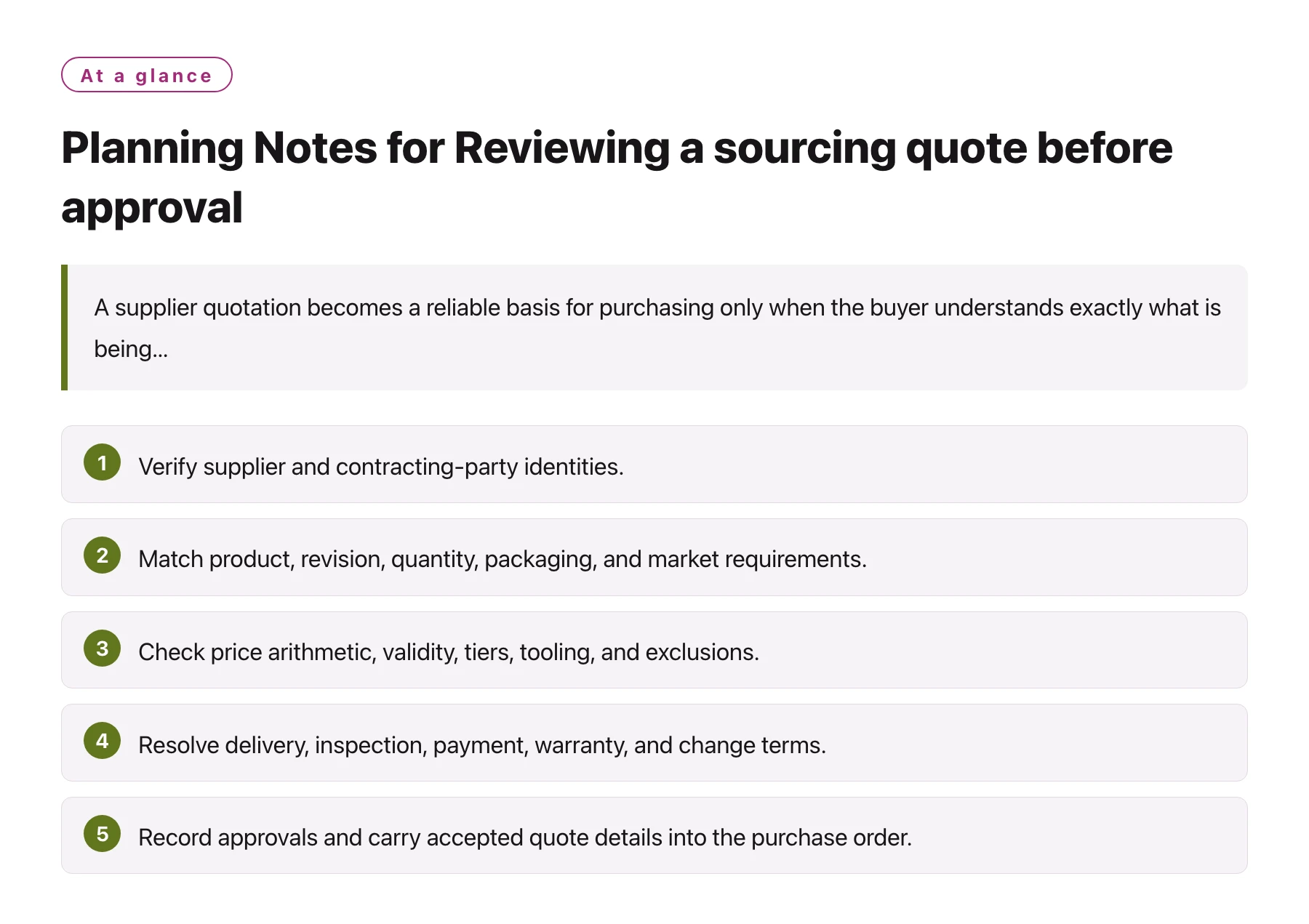
Key takeaways
- Verify supplier and contracting-party identities.
- Match product, revision, quantity, packaging, and market requirements.
- Check price arithmetic, validity, tiers, tooling, and exclusions.
- Resolve delivery, inspection, payment, warranty, and change terms.
- Record approvals and carry accepted quote details into the purchase order.
Use the quote review as a final scope and risk check between sourcing discussions and a binding order commitment.
1. Confirm who made and issued the quotation
Check legal seller name, address, contact, quote number, issue date, currency, validity, and authorized signatory. Identify the actual production site and clarify whether the quoted party is a factory, trading entity, export company, or other intermediary.
Compare payment beneficiary and invoice entity with the contract arrangement. Independently verify changed bank instructions. Keep the proposal and related clarifications together so the offer’s origin and revision can be traced later.
2. Match the offer to the requested product
Compare product name, model, drawing number, material, finish, dimensions, performance, accessories, labels, package, and revision against the request. Look for substitutions, “or equivalent” wording, missing line items, or qualifications in footnotes. Ask the technical owner to decide whether proposed alternatives are acceptable.
Separate product conformity from commercial attractiveness. A low price does not remedy a missing technical requirement. Record every exception with supplier explanation, evidence needed, approver, and decision status before treating the offer as compliant.
3. Validate quantity and unit conventions
Confirm minimum order, order quantity, price breaks, units per pack, units per carton, total pieces, and any overage or tolerance. Ensure the unit price is tied to the same buying quantity and package basis used in the comparison.
Review spreadsheet calculations and extended totals. Check whether tooling, setup, samples, spare parts, or accessories are included or charged separately. Keep one-time and recurring charges visible so a first order can be compared fairly with later production.
4. Check price validity and adjustment clauses
Record currency, quote expiry, tax treatment, payment currency, discount conditions, raw material assumptions, and conditions that permit repricing. Clarify how a change in specification, volume, timing, or exchange rate affects the offer. Do not assume an estimate remains firm after its stated validity.
If a quote includes multiple tiers, identify the price applicable to the actual commitment. Confirm whether discounts depend on annual volume, combined products, deposits, or a purchase schedule that the buyer can realistically meet.
5. Review what the price excludes
Ask whether packing, labels, export cartons, palletization, inspection, testing, documentation, tooling, freight, insurance, brokerage, duties, destination handling, and local delivery are included. Require an amount or written exclusion for material charges.
Translate broad descriptions into operational scope. “Freight included” needs an origin, destination, mode, service boundary, validity, and surcharge basis. “Inspection included” needs scope, timing, method, report, and inspector identity. Keep assumptions distinct from confirmed inclusions.
6. Confirm production and delivery commitments
Check sample approval, material procurement, production duration, inspection window, packaging, dispatch, and delivery milestones. Confirm when lead time begins and whether it depends on deposit, approved artwork, sample signoff, or another event. Compare the promise with demonstrated capacity and known dependencies.
If an Incoterms® rule is used, state its version and exact named place. The ICC rules allocate specified delivery responsibilities, costs, and risks when incorporated into the contract, but the buyer should still check booking duties and quoted local charges. [2]
7. Check inspection and nonconformity provisions
Find the agreed inspection criteria, lot definition, sampling method, access rights, report timing, reinspection charges, and shipment-release authority. Ensure acceptance criteria refer to current specifications and approved samples. Decide whether tests or third-party checks need separate purchase authorization.
ISO 9001 concerns quality management systems; a certification claim does not by itself establish that the quoted product or shipment conforms. Ask for product and lot evidence where relevant, and assign a qualified reviewer to unresolved compliance or safety questions. [1]
8. Examine payment, warranty, and remedies
Review deposit, balance trigger, accepted payment method, currency, bank charges, credit terms, warranty period, defect remedy, cancellation, shortage, delay, and dispute provisions. Confirm who owns tooling and buyer-supplied design information. Have counsel review material contractual risks.
Check that payment milestones correspond to verifiable events and documents. If balance payment depends on inspection or shipment documents, define what evidence is acceptable and who confirms completion. Record any negotiated concession instead of relying on a verbal promise.
9. Resolve open items and control approval
Create a list of unanswered questions, exceptions, required evidence, owner, due date, and effect on approval. Do not approve an offer with critical unknowns unless an authorized risk owner explicitly accepts them and documents mitigation.
Route technical, quality, compliance, finance, and logistics decisions to the right reviewers. Use a versioned approval record that identifies the quote and specification revisions reviewed, the approvers, date, conditions, and any unresolved follow-up.
10. Transfer accepted terms into the purchase order
The purchase order should reference accepted quote revision, product specifications, quantities, unit and total price, packaging, inspection plan, dates, delivery basis, payment, warranty, tooling, and approved exceptions. Reconcile the PO against the final offer line by line before sending it.
Buyers reviewing a proposal with JS Sourcing China sourcing agent can use a controlled checklist to keep supplier facts, quote assumptions, and approvals aligned. Require written supplier acknowledgement and retain the approved document set for production, inspection, receiving, and future disputes.
Sources
Frequently asked questions
Can a buyer approve a quote with unanswered fields?
Only after the responsible owner assesses the gaps, documents assumptions, and approves any required mitigation.
Should the purchase order repeat the quotation terms?
It should incorporate or restate the accepted scope, price, specification, delivery, quality, and commercial conditions.
Does a quality certificate prove the quoted goods conform?
No. Review its scope separately and request evidence tied to the actual product, revision, factory, and lot.
When does a supplier quotation need revision?
Request an updated offer after changes to scope, quantity, specification, delivery point, timing, or validity.