Gross, Net and the Gap: Daily Income at Three Hashrates
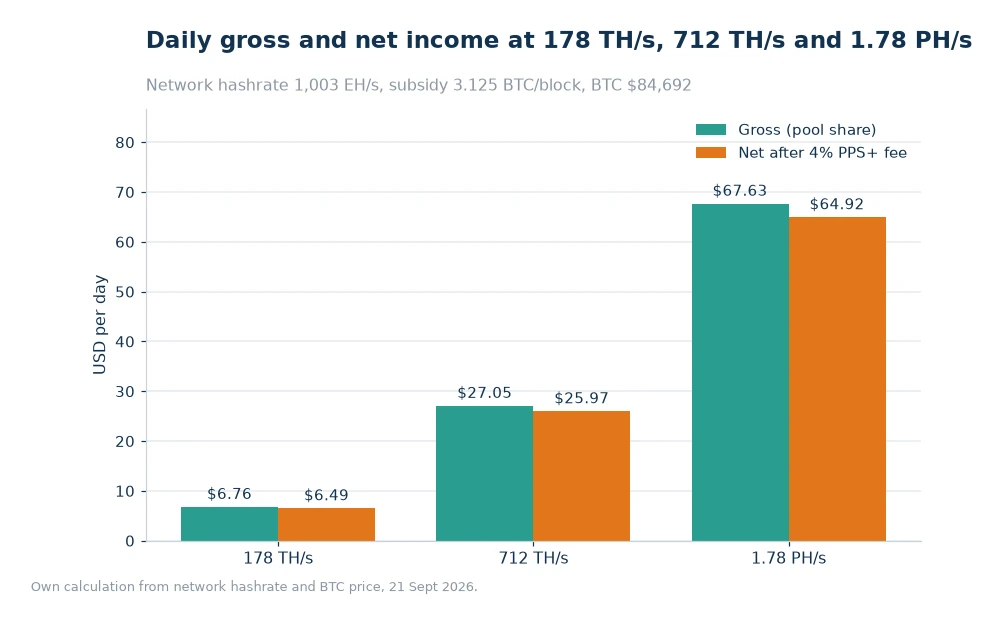
Two miners with the same machine can quote different daily incomes and both be right, because one is quoting gross and the other net. At 178 TH/s the gross credit is $6.76 a day and the net is $6.49; at 1.78 PH/s the pair is $67.63 and $64.92. The gap is small in percentage terms and easy to lose track of when the numbers get bigger.

Key takeaways
- At 178 TH/s, gross is $6.76 a day and net is $6.49, a difference of $0.27.
- At 1.78 PH/s the same rates give $67.63 gross and $64.92 net, a difference of $2.71.
- The listed 4% touches the PPS-settled block reward; the 2% touches the transaction-fee component.
- Scaling from 178 TH/s to 1.78 PH/s is a tenfold multiplication of both columns, not a new calculation.
Where the two numbers diverge
Gross is what the pool credits before its listed fee. Net is what remains after that fee is applied to the component it belongs to. Stating both is not pedantry: a miner comparing a spreadsheet with a payout screen needs to know which one the spreadsheet holds, and the difference compounds quietly across a year.
The complication is that the fee is not a single rate on a single total. Under PPS+, the default, the block-reward component is settled on a PPS basis with a listed 4%, and the transaction-fee component follows PPLNS logic with a listed 2%. Those are two rates on two parts of the same credit, not a combined 6% on everything. At the hashrates below, the block reward is the dominant part, so the net figure sits close to 96% of gross.
Three scales, one table
The table uses the daily credit derived from 450 BTC a day across a 1,003 EH/s network, valued at $84,692 per BTC. Net applies the listed 4% to the block-reward component.
| Hashrate | Daily BTC | Gross USD/day | Net USD/day | Fee retained |
|---|---|---|---|---|
| 178 TH/s | 0.00007985 | $6.76 | $6.49 | $0.27 |
| 712 TH/s | 0.00031940 | $27.05 | $25.97 | $1.08 |
| 1.78 PH/s | 0.00079852 | $67.63 | $64.92 | $2.71 |
The four rows of thought that follow from this table are more useful than the table itself. First, the fee scales with income, so it never becomes irrelevant. Second, the percentage gap is stable across the three scales, which means a bigger operation does not get a better rate by being bigger. Third, the dollar gap is what a hosting invoice has to beat, not the percentage. Fourth, the net column is the one that should be compared with costs, because a cost comparison against gross flatters every machine.
Worked example
Start with 178 TH/s and check each column.
- 450 BTC a day ÷ 1,003,000,000 TH/s = 0.00000044865 BTC per TH/s per day.
- 178 TH/s × 0.00000044865 = 0.000079860 BTC a day, shown as 0.00007985 after rounding.
- 0.00007985 × 84,692 = $6.763, which the chart rounds to $6.76.
- 4% of $6.76 is $0.2704, so net is $6.76 − $0.27 = $6.49.
- 712 TH/s is four times 178: 4 × 0.00007985 = 0.0003194 BTC, and 0.0003194 × 84,692 = $27.05.
- 1.78 PH/s is ten times 178: 10 × 0.00007985 = 0.0007985 BTC, and 0.0007985 × 84,692 = $67.63.
- Net at 1.78 PH/s: $67.63 × 0.96 = $64.92, matching the table.
- The small discrepancies in the middle row come from rounding the BTC figure before multiplying by the price, not from a different fee.
Where the 2% actually sits
The transaction-fee component is the part miners forget, because on a quiet chain it is a small share of the block reward. When blocks are full it grows, and the 2% rate applies to it instead of the 4%. A miner who models everything at 4% will be slightly pessimistic in a busy period and slightly optimistic in a quiet one, and either way the error is in the cents at these hashrates.
PPLNS changes the shape of the same question. It applies a listed 2% to the combined block reward and fees, which is a lower rate than the PPS+ block-reward rate, and it pays after six confirmations with the miner's slice measured over the last five difficulty rounds. The trade is explicit: a lower listed rate in exchange for carrying pool variance. For a miner with a fixed monthly power bill, the steadier PPS+ series is often worth the higher listed rate on that component.
Scaling is linear until it stops being
Going from 178 TH/s to 1.78 PH/s multiplies the income by ten and, in the arithmetic above, nothing else changes. In practice two things break the line. The first is power: ten times the hash usually means about ten times the draw, so the electricity line scales with the revenue and the margin stays proportional rather than growing.
The second is operational. Ten machines need more cooling, more network ports and more attention than one, and the failure rate is ten times higher in absolute terms even if it is identical per unit. A miner planning the jump should budget for the second effect separately, because it does not appear in any hashrate table and it does appear in the monthly accounts.
Checking the figures against the account
Once a week, compare the pool's reported daily credit with the table for your hashrate. A shortfall of a few percent is usually uptime; a shortfall of 20% is usually a board or a thermal problem. The comparison only works if both sides use the same definition, which is why the gross and net split at the top of this article matters more than it first appears.
The ViaBTC Mining Pool account is where the credited amount appears, and the fee schedule shows which component each listed rate applies to, so a miner can reconstruct the net figure rather than guessing at it. Set the two side by side once, and the spreadsheet stops drifting away from reality.
What the net figure is good for
Net daily income is the right number for three decisions: whether a machine covers its power, whether a hosting fee leaves anything behind, and whether a replacement rig would improve the margin. It is the wrong number for comparing two coins or two pools, because those comparisons need the gross rate and the variance as separate inputs.
Keeping both columns in the same sheet costs nothing and prevents the most common accounting error in small mining: subtracting a fee twice, once in the estimate and again in the invoice check. The table above is a template for that sheet, with the only variable being the hashrate in the first column.
Frequently asked questions
How much is the fee at 178 TH/s?
About $0.27 a day on $6.76 of gross credit, which is the listed 4% applied to the block-reward component at BTC $84,692 and a 1,003 EH/s network.
Is the fee 4% or 6%?
Neither figure describes the whole credit. PPS+ lists 4% on the block-reward component and 2% on the transaction-fee component, and because the block reward dominates at these hashrates the net lands close to 96% of gross.
Does a larger hashrate get a lower rate?
No. The listed rates apply to the components rather than to the size of the account, so the percentage gap between gross and net stays close to the same at 178 TH/s and at 1.78 PH/s.
Put net income on the top line
A single number decides most small mining questions: net daily income at the hashrate you own, at today's difficulty. Everything else, from the power contract to the hardware choice, is measured against it. Gross is useful for checking the pool's arithmetic; net is useful for deciding whether to keep going.
The Profit Calculator produces that number from current inputs, and the multi-currency wallet shows what actually arrived after the fee was taken. Compare the two monthly, and the gap between the model and the account stays small enough to trust.
Sources: the ViaBTC state, pricing, calculator and wallet pages, with chain data read 21 Sept 2026[1]. Network hashrate 1,003 EH/s, difficulty 132.76 T, 3.125 BTC per block, 144 blocks a day, BTC $84,692. Published 22 Oct 2026; figures are arithmetic on those inputs and assume continuous uptime.