What Actually Drives the Unit Cost of a Perfume
Two suppliers can quote the same brief and land far apart, and the gap is rarely explained by the smell. A fragrance unit cost is assembled from four blocks: what goes into the compound, what contains it, what closes and carries it, and the labour and paperwork around filling. Knowing the blocks makes it possible to reduce a quote without quietly reducing the product.
Key takeaways
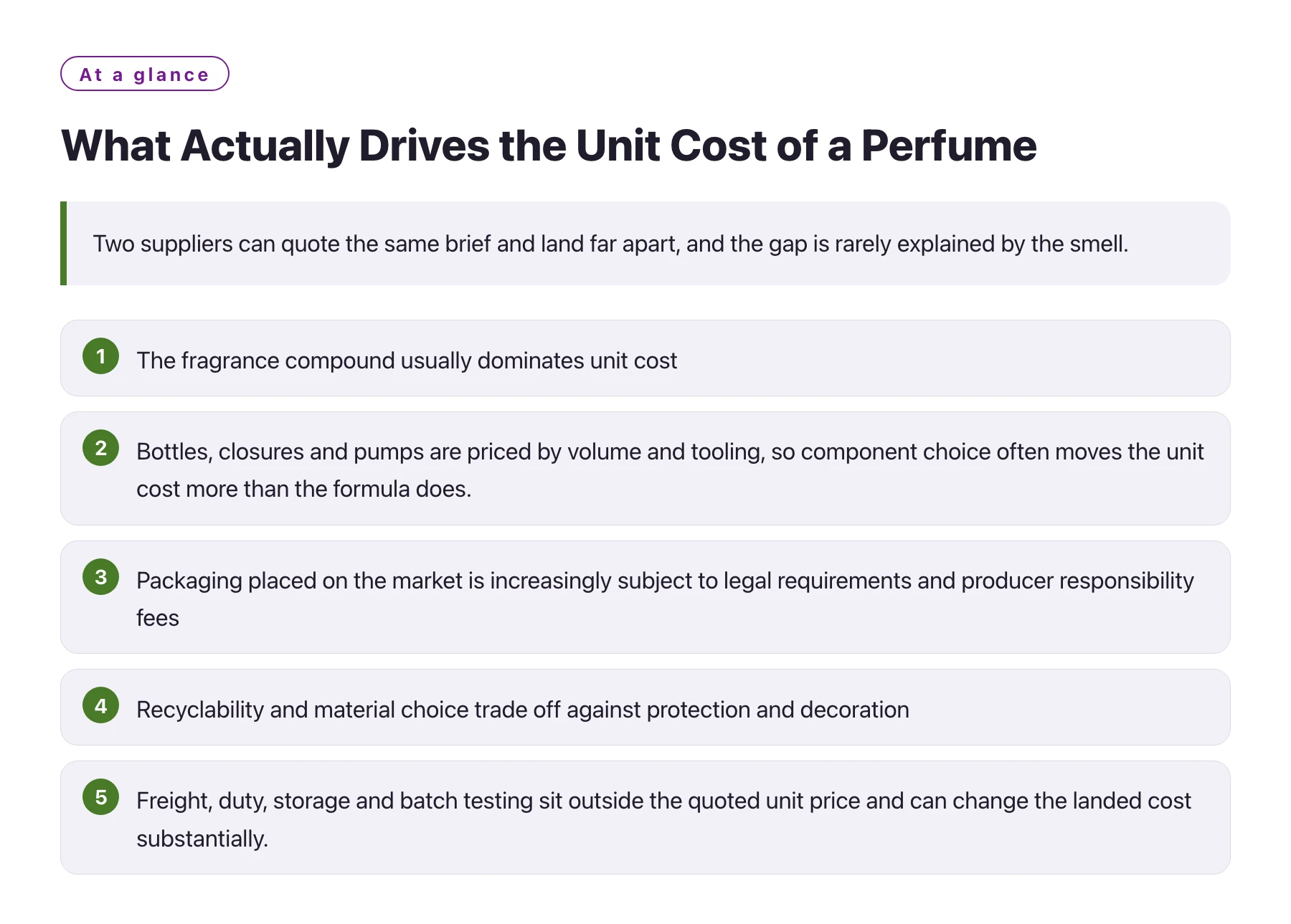
- The fragrance compound usually dominates unit cost, because aroma materials are the most expensive input per kilogram in the whole bill of materials.
- Bottles, closures and pumps are priced by volume and tooling, so component choice often moves the unit cost more than the formula does.
- Packaging placed on the market is increasingly subject to legal requirements and producer responsibility fees, which belong in the cost model from the start [1].
- Recyclability and material choice trade off against protection and decoration, and most of that trade-off is settled at the design stage rather than in production [2].
- Freight, duty, storage and batch testing sit outside the quoted unit price and can change the landed cost substantially.
A costing conversation about a perfume usually starts in the wrong place. The first question tends to be about the price of the bottle, or about the price per kilogram of the fragrance, and both answers are meaningless until the quantity, the format and the market are fixed.
The reason is that unit cost is a ratio: total project cost divided by units produced. Every block of that cost behaves differently as volume rises. Some fall steeply with quantity, some barely move, and one or two actually increase when the packaging gets more elaborate.
This article breaks the quote into its parts, shows which levers genuinely reduce cost, and lists the charges that appear after the quotation has been signed.
The four blocks behind a perfume quote
| Cost block | What sits inside it | How it behaves with volume | Where there is room to negotiate |
|---|---|---|---|
| Fragrance compound | Aroma materials, blending and any restricted-material allowances | Falls per unit as quantity rises, but slowly | Formula structure and material substitution |
| Primary packaging | Bottle or container, closure, pump, rollerball or sprayer | Falls sharply once tooling is amortised | Choice of standard moulds and finishes |
| Secondary packaging | Carton, insert, shrink wrap, gift box, labels | Falls with print run length but adds a new setup each time | Board weight, print colours, number of components |
| Filling and assembly | Blending, resting, filling, capping, labelling, packing, QC | Partly fixed, partly linear with units | Format complexity and how much is done by hand |
| Documentation and testing | Safety file, declarations, batch testing, shipping papers | Largely fixed per project rather than per unit | Scope and sequencing rather than price |
Notice that only the first block is about the smell. The other four are about decisions that can be revisited without touching the formula, which is why a cost review that starts and ends with the fragrance usually misses most of the available savings.
Why the compound dominates, and how to reduce it honestly
Aroma materials are traded commodities with their own supply patterns, harvest variability and price movement. Houses that supply the industry describe their business in terms of ingredient portfolios and market segments, which is a reminder that the material list in your formula is exposed to markets far outside your project [3].
That exposure is manageable, but only if it is discussed before the formula is frozen.
Material cost follows the formula, not the tier name
Two formulas carrying the same percentage of fragrance compound can differ enormously in cost, because a natural absolute and a synthetic reconstruction of the same idea are priced very differently per kilogram. The tier on the label tells you nothing about that spread.
This is also the reason a cost target and an olfactive target sometimes conflict. A perfumer can usually hit a direction at several price points, but the result will not be identical, and pretending otherwise leads to disappointing bulk.
Three levers worth pulling before sampling
The first is concentration, which is the most direct lever and also the one with the clearest consequences for performance. Lowering it saves material cost and changes wear time.
The second is the material palette. Substituting a costly natural with a well-built reconstruction can protect the character of the scent at a lower cost, provided the brief is explicit that this is acceptable.
The third is the size of the range. Building several products around one compound, adjusted in concentration or in the carrier, spreads development cost across a family instead of a single item.
How to re-cost a product without downgrading it
- Fix quantity, format and market firstEvery block of the cost model depends on these three variables, so a quote requested without them cannot be compared to anything.
- Ask for the quote in the same four blocksInsist on compound, primary packaging, secondary packaging and filling as separate lines, so you can see where the difference between two suppliers actually sits.
- Challenge the component before the formulaStandard moulds, fewer decoration steps and a lighter carton board usually save more per unit than a reformulation, and they do not change how the product smells.
- Price the decoration honestlyMetallising, coating, embossing and multi-pass printing each add a setup cost that only makes sense above a certain run length.
- Model the landed cost, not the unit priceAdd freight, duty, insurance, storage and any producer responsibility fee before comparing suppliers, because a cheaper unit price can lose on delivery.
- Re-run the model at two volumesCost the same product at your planned volume and at a smaller trial volume; the difference tells you where the fixed costs are concentrated.
The costs that ruin a launch budget are almost never on the quotation. They are the packaging fee that appears with the first tax return, the storage charge for a container that arrived before the warehouse was ready, the reprint caused by a late change to the ingredient declaration, and the air freight paid to rescue a retail date. Treat the quoted unit price as roughly two-thirds of a landed cost until you have modelled the rest. This is not pessimism; it is how the arithmetic works when a product crosses a border and then sits in a warehouse.
The charges that arrive after the quote
Once the product leaves the filling line, a second cost model starts running. Some of it is transport, and some of it is regulatory — and the regulatory part is growing.
Both belong in the original budget, because neither can be negotiated downwards later.
Packaging rules and producer fees
Rules on packaging and packaging waste increasingly determine what a package may be made of, how much material it may use and how it must be collected or recycled. Producer responsibility fees attach to packaging placed on a market, which means the fee is driven by the packaging decision rather than by the sales volume alone [1].
Industry guidance on material choice and recyclability is where the practical trade-offs are documented, including the tension between a fully recyclable mono-material design and one that protects a fragile bottle through transit [2].
Freight, duty and working capital
Ocean freight is priced by volume and weight, and a gift box design that adds a few centimetres of dimension per unit multiplies through a container. Duty and tax depend on classification and origin, and they are calculated on the value declared at import.
Personal care coverage follows ingredient cost, packaging and contract manufacturing as commercial matters rather than as creative ones, which is the right frame for this part of the budget [4].
Make the model visible to the people who decide
Cost reviews fail when the person choosing the bottle has never seen the freight consequence of its dimensions. A single shared sheet with the four blocks, the landed-cost columns and the volume assumptions resolves most arguments before they begin, because it replaces preference with arithmetic.
A full-service house will normally publish how it describes its own scope, and looking at the official Xuelei website is a reasonable way to see the categories and services a manufacturer of this kind presents before you build a comparable sheet of your own.
Sources
- European Commission: Packaging Waste and the PPWR —— EU rules on packaging and packaging waste, including the Packaging and Packaging Waste Regulation requirements on recyclability and design.
- Sustainable Packaging Coalition —— A membership organisation working on more sustainable packaging design, publishing material and recyclability guidance.
- Givaudan —— One of the largest fragrance and flavour houses; public material on fragrance creation, ingredient portfolio and market segments.
- HAPPI — Household & Personal Products Industry —— An industry magazine covering the household and personal care market, including fragrance, formulation and packaging.
Frequently asked questions
Why is the fragrance compound the biggest cost in a perfume?
Because aroma materials are the most expensive input per kilogram in the bill of materials, and the compound is what makes the product what it is. Packaging can be substituted and filling can be automated, but the material list is limited by the olfactive brief and by any restrictions that apply to those materials.
How can I lower a perfume unit cost without changing the smell?
Work on everything except the formula first. Standard components, fewer decoration steps, a lighter carton and a simpler assembly reduce unit cost without touching the juice. Only after those options are exhausted is it worth discussing concentration or material substitution with the perfumer.
Does a larger order always reduce the unit price?
It reduces the parts of the cost that are fixed per run, such as tooling setup, blending and documentation. It reduces material costs more slowly, because the compound and much of the packaging are priced per unit. The steepest savings usually appear between the trial run and the first full production run.
What is a landed cost and why does it matter more than the quote?
Landed cost is the delivered cost of a unit once freight, duty, insurance, storage and any packaging fees are included. It matters because these charges are volume-driven and easy to underestimate, and a supplier with a lower unit price can still be the more expensive option by the time the container reaches your warehouse.
Should I choose packaging before or after the formula?
Choose the component family before the formula is final, because component availability constrains format and minimum order. Lock the printed decoration after the formula, so that the ingredient and allergen declarations on the artwork match the product you are actually filling.